Welcome to the vucca world – Part II
Originally published in Human Futures Magazine (August 2022)
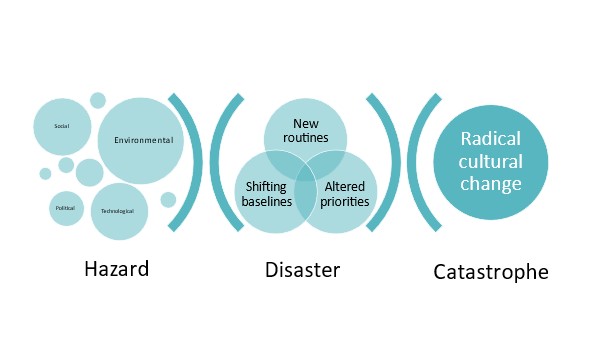
Departing from the original meaning of the word, a catastrophe is a process of dramatic transformation that results in an altered situation that is not necessarily worse than the initial situation. While today the term is synonymous with exceptionally severe and lethal disasters, it seems more expedient to use it to describe what comes after a dangerous situation, i.e. to describe the effects of a sequence of hazard and disaster that sustainably transform a society.
In the case of 3/11, the most notable of these effects has been the revaluation of nuclear energy in many countries across the world, with countries like Germany and Switzerland phasing-out nuclear energy and investing substantially in alternative energy sources. The so-called Boxing Day tsunami in late 2004 led to substantial population movement and drastic changes in the composition of regional economies and agriculture (Tomas & Frankenberg, 2014). Hurricane Katrina that devastated New Orleans in 2006 resulted among other things in an improvement of the local job market (Fleisher, 2018). For Covid-19, the catastrophic long-term effects are only beginning to show but are likely to include a new attitude towards public health, working from home, consuming regional products, and trading wild-life species.
These effects have transformed societies, economies, and values. They are thus catastrophic in the original sense of the term.
Nevertheless, these catastrophic cultural effects are hardly, if ever, considered in political discussion, insurance contracts, legislation, or even academic discourse. Reasons for this may be the substantial differences in
- time: some catastrophic processes become visible immediately after the events as in the case of Fukushima, others unfold more slowly and can only be recognised years after the hazard
- scale: while catastrophe has been defined above as ‘radical cultural change’, the culture that changes may range from that of a group within society, an organisation, a nation or even the global community
- visibility: the transformation can be easily visible (like airport security checks after 9/11), or more subtle
- scope: changes may occur in a specific realm of society or transcend every area of it
In some cases, especially in those where subtle changes occur over a longer period after the hazard and on a small scale, it is difficult to distinguish catastrophe from continuous processes of adaptation. It is thus useful to define catastrophe as a process that directs the development of a society towards a new, previously unthought of or unlikely direction. This means that the normalcy that was disrupted by disaster is not merely not restored, but indefinitely lost, as catastrophe creates a new reality. For those affected, what used to be normal dies with disaster.
In the Anthropocene, the new reality created by disaster is unlikely to persist for long as the frequency and intensity of hazards increases while the accelerating vuca world elevates global societies’ vulnerability to disasters. Instead, catastrophe may become the ‘new normal’.
Why catastrophe is likely to become a permanent state
According to the latest IPCC report (IPCC, 2021), the frequency and intensity of weather and climate hazards is, and will continue to, increase in the decades to come. They will affect every society and region on the planet. Consequently, the World Economic Forum’s latest Risk Report lists extreme weather as one of the top critical threats to the world that is already clear and present (World Economic Forum, 2021, p.11). In addition to extreme weather events, climate change will likely trigger a global increase in infectious diseases (Thomas, 2020) and possibly even earthquakes (Buys, 2019).
Along with these rapid-onset hazards, rising sea levels, the progressive reduction of yields or extended dry periods will affect an increasing portion of the world’s population. Unlike extreme events that take only hours or days, cause instantly visible disruption, and may result in catastrophe, many of those slow-onset hazards happen simultaneously to a certain kind of catastrophe: What is considered ‘normal’ among the affected changes while the condition continues. This ‘amnesia’ is known as shifting baselines syndrome and has been observed and studied for varying perception among different generations (Jones et al., 2020). The acceleration of environmental, technological, and social change that is already visible and expected to exacerbate, however, is likely to cause baselines to shift – maybe even several times – within one generation. This constant state of flux makes it even less likely that effective measures tackling the causes or timely action alleviating the consequences are taken.
Apart from extreme weather phenomena and climate-related slow-onset hazards, geophysical hazards like earthquakes and volcanic eruptions that are not directly related to climatic change but cannot be predicted accurately will have an increasing impact on the growing megacities in volcanic and earthquake-prone areas. Regions like Central America and South-East Asia are frequently shaken by seismic activity and, as the example of Haiti demonstrates, may enter a state of deep catastrophe afterwards. Other megatrends like the ongoing increase in global trade and international mobility, the increasing connectivity of diverse actors, rapidly aging populations and growing wealth inequality exacerbate risk from hazards as well. Moreover, in the context of accelerated transformation of the natural, social, and technological spheres, novel hazards are likely to emerge.
Although not every hazard causes disaster or catastrophe, it is unlikely that communities that are frequently and intensely hit by hazards can cope with their effects without entering a phase of radical cultural change. In contrast, it can be assumed that the frequency and intensity of occurring hazards are proportional to the continuity and profoundness of transformative processes within the affected societies.
In short: many societies in the world are likely to enter a state of permanent catastrophe or a vucca world.
Conclusion: Catastrophes as a major challenge for Futures Studies
Global climate change is likely to cause a substantial increase in various kinds of (natural) hazards in the decades to come. In combination with every more tightly connected societies and economies that evolve at an ever faster pace as well as complex technological systems that permeate global infrastructure and a steady population increase in the world’s most hazard-prone areas, these hazards are more than ever likely to cause disaster and, ultimately, catastrophe.
As the catastrophic processes are protracted while the intervals of hazards will become continuously shorter, “new” catastrophic developments will be kicked-off before the previous ones have been completed, and old and new catastrophes will overlap. The world of the Anthropocene will thus indeed be in a state of permanent catastrophe as the thinkers of the Frankfurt School predicted.
Living and coping with this ‘new normal’ will not only require new ways to predict, prepare for, and cope with known and yet unknown hazards. It will also be crucible to establish novel types of political and social leadership, innovative ways of planning for the future, creative approaches to communication and education, ideas on how to tackle social inequality and other factors directly contributing to vulnerability as well as continuing research into the resilient design of infrastructure and organisations.
Futures Studies and Foresight have the potential to facilitate this process by co-creating convincing scenarios of possible futures that reduce anxiety and help identify new options, by engaging diverse perspectives into the building of strategies that provide guidance within a rapidly and radically changing environment, and by enabling people to take the first steps towards creating a desirable future despite all environmental challenges.
To do so, they need to acknowledge catastrophe as an inherent feature of the future and accept the responsibility to shape the vucca world. By establishing a novel understanding of catastrophes as processes of radical cultural change with negative or positive outcomes – thus going back to roots of the ancient Greek term – Futures Studies and Foresight can lay the foundation for the permanent catastrophe’s evolving into an opportunity for continuous improvement.
References
Bassetti, F. (2019). Environmental Migrants: Up to 1 Billion by 2050. Foresight, The CMCC observatory on climate policies and futures. Retrieved August 27, 2021, from: https://www.climateforesight.eu/migrations-inequalities/environmental-migrants-up-to-1-billion-by-2050/
Boin, A.; t’Hart, P. & Kuipers, S. (2017). The Crisis Approach. In H. Rodriguez et al. (Eds.), Handbook of Disaster Research (pp. 42-54). Cham: Springer International Publishing AG.
Boin, A. (2005). From Crisis to Disaster: An Integrated Perspective. In R. Perry & E. Quarantelli (Eds), What is a Disaster? New Answers to Old Questions (pp. 153-172). N.p.: International Research Committee on Disasters.
Borrelli, P., Robinson, D.A., Panagos, P., Lugato, E., Yang, J.E., Alewell, C., Wuepper, D., Montanarella, L. & Ballabio, C. (2020). Land use and climate change impacts on global soil erosion by water (2015-2070). Proceedings of the National Academy of Sciences Sep 2020, 117 (36) 21994-22001; DOI: 10.1073/pnas.2001403117
Büntgen, U., Urban, O., Krusic, P.J. et al. (2021). Recent European drought extremes beyond Common Era background variability. In Nat. Geosci. https://doi.org/10.1038/s41561-021-00698-0
Burrell, A.L., Evans, J.P. & De Kauwe, M.G. Anthropogenic climate change has driven over 5 million km2 of drylands towards desertification. Nat Commun 11, 3853 (2020).
Buys, A. (2019). Can Climate Affect Earthquakes, Or Are the Connections Shaky? NASA Global Climate Change. Retrieved September 24, 2021, from: https://climate.nasa.gov/news/2926/can-climate-affect-earthquakes-or-are-the-connections-shaky/
Cook, R. (1998). How Complex Systems Fail. Retrieved June 21, 2021, from: https://how.complexsystems.fail/
Dixon, S. & Gawley, T. (2017). Crude Exploration: Portraying Industrial Disaster in Deepwater Horizon. New Solutions 27(2), pp. 264-272.
Etkin, D. (2016). Disaster Theory. An Interdisciplinary Approach to Concepts and Causes. Oxford: Elsevier.
Fleisher, C. (2018). Making a fresh start. What was the long-term impact of Hurricane Katrina on its victims’ earnings? American Economic Association. Retrieved May 02, 2021, from: https://www.aeaweb.org/research/new-orleans-katrina-long-term-recovery-income
Fritsche, I., Cohrs, C., Kessler, T. & Bauer, J. (2012). Global warming is breeding social conflict: The subtle impact of climate change threat on authoritarian tendencies. Journal of Environmental Psychology, Vol. 32, Issue 1, pp. 1-10.
Intergovernmental Panel on Climate Change (2021). Climate Change 2021. The Physical Science Basis. Summary for Policy Makers. Retrieved August 21, 2021, from: https://www.ipcc.ch/report/ar6/wg1/downloads/report/IPCC_AR6_WGI_SPM.pdf
International Committee of the Red Cross (2020). Climate change in the Central African Republic: what threats? Retrieved March 27, 2021, from https://www.icrc.org/en/document/climate-change-central-african-republic-what-threats
Jones, L.P.; Turvey, S.T.; Massimino, D. & Papworth, S.K. (2020). Investigating the implications of shifting baselines syndrome on conservation. People & Nature 2020: 2, p. 1131-1144.
Kelman, I. (2020). Disaster by Choice. How our Actions turn Natural Hazards into Catastrophes. Oxford: Oxford University Press.
McCurry, J. (2015). Japan remembers the 18,000 victims of 2011’s triple disaster. The Guardian. Retrieved September 20, 2021, from https://www.theguardian.com/world/2015/mar/11/japan-remembers-the-18000-victims-of-2011s-triple-disaster-fukushima
Mendonça, S., Cunha, M. P., Kaivo-oja, J., & Ruff, F. (2004). Wild cards, weak signals and organisational improvisation. Futures, 36(2), 201–218.
Oliver-Smith, A. (2002). Theorizing Disasters: Nature, Power and Culture. In S.M. Hoffman & A. Oliver-Smith (Eds.), Catastrophe and Culture. The Anthropology of Disasters. (pp. 23-48) Santa Fe: SAR Press.
Ossimitz, G.; Lapp, C. (2006). Katastrophen – systemisch betrachtet. Wissenschaft & Umwelt – INTERDISZIPLINAER 10, pp. 51-62.
Perry, R. (2005). Disasters, Definitions, and Theory Construction. In R. Perry & E. Quarantelli (Eds): What is a Disaster? New Answers to Old Questions. (pp. 311-324) International Research Committee on Disasters.
Quarantelli, E. (2000). Emergencies, Disaster and Catastrophes are Different Phenomena. University of Delaware Disaster Research Center. Retrieved May 20, 2021, from: https://udspace.udel.edu/bitstream/handle/19716/674/PP304.pdf?sequence=1&isAllowed=y
Schwab, K. (2018). The Future of the Fourth Industrial Revolution. London: Penguin Books.
Shackleton, M. (2019). The Great Forest Wall: A plan to protect Japan from future mega-tsunami. Retrieved September 20, 2021 from: https://forumtauripress.com/wp-content/uploads/2019/05/Michael-Shackleton.pdf
Thomas, D. & Frankenberg, E. (2014). Boxing Day tsunami: the resilience and recovery that followed. The Conversation. Retrieved April 26, 2021, from: https://theconversation.com/boxing-day-tsunami-the-resilience-and-recovery-that-followed-35803
Thomas M. B. (2020): Epidemics on the move: Climate change and infectious disease. PLoS Biol 18(11). Retrieved from: https://doi.org/10.1371/journal.pbio.3001013
Toner, J. (2013): Roman Disasters. Cambridge: Polity Press.
UNDRR (2017): Terminology. Retrieved May 18, 2021, from: https://www.undrr.org/terminology
UNISDR (2015): Proposed Updated Terminology on Disaster RiskReduction: A Technical Review. Background Paper. Retrieved March 31, 2021, from: https://www.unisdr.org/files/45462_backgoundpaperonterminologyaugust20.pdf
UNISDR (2009). UNISDR Terminology on Disaster Risk Reduction. Geneva. Retrieved March 31, 2021, from: https://www.unisdr.org/files/7817_UNISDRTerminologyEnglish.pdf
Walter, J. (2019). Erdbeben im antiken Mittelmeerraum und im frühen China. Vergleichende Analyse der gesellschaftlichen Konstruktion von Naturkatastrophen bis zum 3. Jahrhundert n.Chr. Berlin: Logos.
World Economic Forum (2021). The Global Risk Report 2021, 16th Edition. Retrieved August 20, 2021, from: http://wef.ch/risks2021
Zukunftsinstitut (2021). Die Megatrends. Retrieved August 25, 2021, from: https://www.zukunftsinstitut.de/dossier/megatrends/